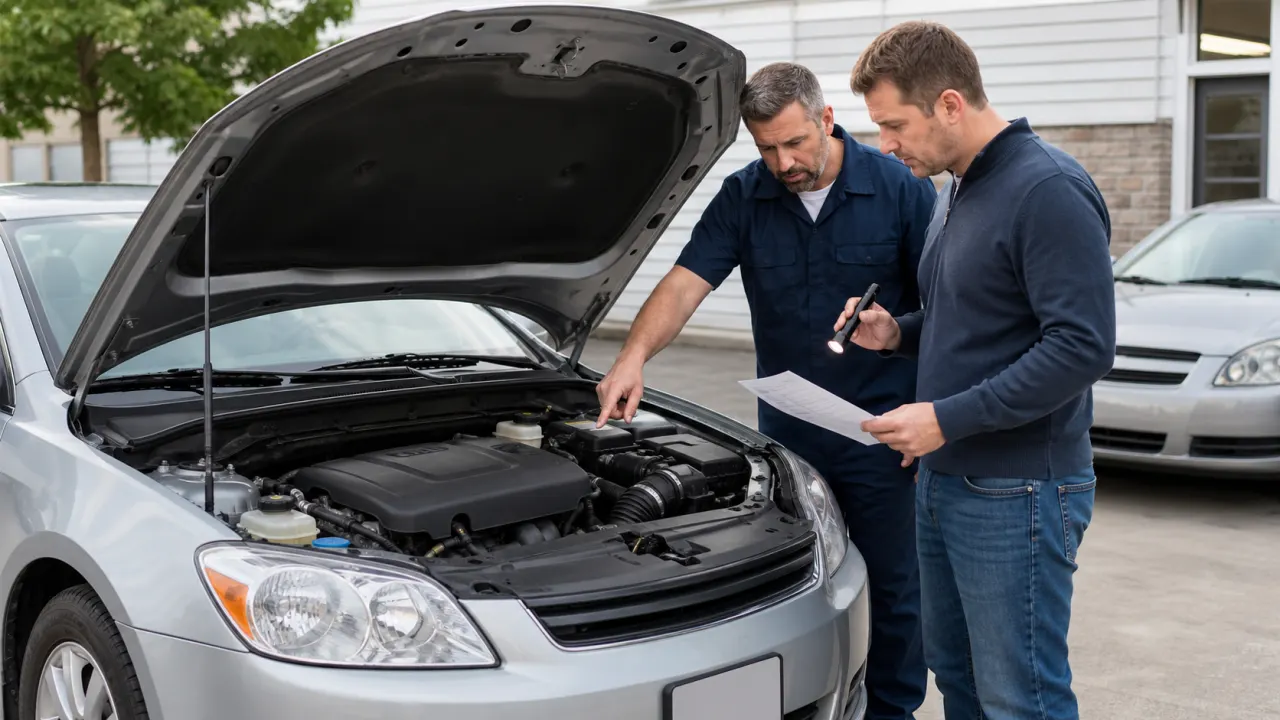
A used car can look excellent in photos and still hide expensive mechanical, electrical, or structural problems. Fresh paint, a clean interior, attractive mileage, a low price, and a confident seller description are useful information—but none proves that the vehicle is a sound purchase.
A systematic checklist helps you evaluate the same essentials on every car. It cannot reveal every fault or replace a mechanic, but it can expose warning signs before money changes hands.
The practical rule: Verify the history, inspect the car in good conditions, test every system you can, drive it carefully, and have a qualified independent mechanic examine it before you buy.
Before You Go See the Car
Save time by getting basic answers before arranging a visit. Ask the seller for:
- The full VIN
- The year, make, model, trim, and current mileage
- How long they have owned the car and how it was used
- Why it is being sold
- Any accident or damage history
- Major repairs or modifications
- Available service records and receipts
- Any current warning lights or known faults
- Whether the title is clean, salvage, rebuilt, or otherwise branded
- Whether a loan or lien remains on the vehicle, where applicable
Confirm the specification and research common maintenance needs for that model, engine, transmission, and year. Check market value and compare current used-car listings on DealsNonStop with similar mileage, trim, condition, and location.
If buying from a private seller, meet somewhere safe and suitable for an inspection and test drive.
Check the VIN and Vehicle History
The VIN identifies the specific vehicle. Compare it in several places—the dashboard plate, driver's-door label, title or registration, and service documents. Characters should match exactly, and visible VIN plates should not appear altered.
Use reputable records available in your country or region to check for:
- Reported accidents or major damage
- Salvage, rebuilt, flood, or other title brands
- Previous owners and registration locations
- Mileage readings that do not follow a logical sequence
- Reported theft status where such records are available
A history report is helpful but incomplete. Repairs, collisions, floods, or maintenance may never have been reported to its data sources. A clean vehicle history report does not replace a physical inspection or pre-purchase inspection.
Inspect the Car in Daylight
Arrange the viewing during daylight, preferably on a dry day with the car parked on level ground. Poor light and wet bodywork can hide paint differences, dents, scratches, rust, and panel damage. Level ground makes stance and fluid levels easier to judge.
Ask the seller not to start the car before you arrive. Bring a flashlight, paper towels, gloves, and this checklist. Never crawl beneath an unsupported vehicle.
Exterior Inspection Checklist
Walk around the car slowly and view each side from several angles.
Body panels
Check for uneven gaps between panels, different paint shades, overspray on rubber or trim, dents, deep scratches, and doors, hood, or trunk that do not align or close normally. Look along reflections in the body for waviness.
These clues can indicate previous repairs but do not automatically make the car unacceptable. Repair quality and any structural or safety involvement matter most. Ask what happened and request invoices.
Rust and corrosion
Inspect wheel arches, door bottoms, rocker panels, trunk edges, visible underbody areas, and suspension mounting areas you can see safely. Light surface discoloration on an exposed part differs from flaking metal, holes, swelling seams, or corrosion affecting the frame and mounting points. Serious structural corrosion requires professional evaluation.
Glass and lights
Look for windshield chips or cracks and verify that side windows and mirrors are intact. Test headlights, high beams, brake lights, turn signals, reverse lights, and fog lights if equipped. Cloudy lenses may reduce output; trapped moisture can indicate a sealing problem.
Tire Checklist
Tires reveal both immediate replacement costs and possible clues about the car. Check:
- Tread depth across the full width of every tire
- Uneven wear on inner, center, or outer edges
- Cracks, cuts, bulges, or sidewall damage
- Matching tire sizes and suitable load and speed ratings
- Tire manufacturing dates, where marked and readable
- Whether all four tires are appropriate for the vehicle and season
Uneven wear may be associated with incorrect pressure, alignment, worn suspension components, or other causes; it does not diagnose one fault. Pronounced wear needs professional inspection. Tire differences can also matter on some all-wheel-drive vehicles.
Look Under the Car
Use a flashlight from outside the car to look for fresh oil, coolant, transmission fluid, or other leaks; damaged covers; crushed areas; excessive corrosion; and loose or damaged exhaust parts. Check the ground where the car was parked.
A few drops or old stains deserve investigation but do not establish the severity or source. Clear water beneath the air-conditioning drain can be normal. Ask an independent mechanic to identify unfamiliar fluid and estimate the repair.
Engine Bay and Fluid Inspection
Inspect the engine when cold if possible. A seller who warms it before you arrive may simply have used the car, but a warm engine can make cold-start rattles, weak starting, smoke, or rough idle harder to observe.
With the engine off, check the accessible oil, coolant, brake fluid, and power-steering fluid where the vehicle uses it. Look for low levels, fresh leakage, cracked or swollen hoses, loose wiring, battery-terminal corrosion, obvious nonstandard modifications, and strong fuel or burning smells. Follow the owner's manual because layouts and procedures vary.
Never remove a radiator or coolant reservoir cap while the engine is hot. Pressurized hot coolant can cause severe burns.
Check the engine oil
If the vehicle has a dipstick, follow its prescribed checking procedure and confirm that the level is within the marked range. Extremely low oil, metallic particles, heavy deposits visible through the filler opening, or unusual contamination needs further investigation. Dark oil by itself does not prove an engine is bad; oil can darken during normal use. Oil appearance is a clue, not a complete diagnostic test.
Start the Car From Cold
Before starting, switch the ignition on and observe the dashboard. System warning lights normally illuminate briefly as a bulb and system check, then turn off according to the vehicle's design after startup. A light that never appears, remains illuminated, or returns requires an explanation and proper diagnosis.
Pay particular attention to the check-engine, ABS, airbag, oil-pressure, battery or charging, and temperature warnings. Do not ignore a warning merely because the car seems to drive normally.
During startup, ask:
- Does the engine start promptly without repeated attempts?
- Does it settle into a reasonably smooth idle?
- Are there knocking, persistent tapping, grinding, or squealing sounds?
- Is there excessive or persistent exhaust smoke?
- Do warning messages remain on the display?
A small amount of water vapor from condensation during a cold start can be normal. Persistent, dense, or unusual smoke deserves professional investigation. Smoke color alone is not enough to declare a particular engine failure.
Interior Inspection Checklist
Check the seats, seat adjustments, seat belts, dashboard, carpets, mats, and headliner. Wear should be broadly believable for the stated age and mileage. Heavily worn pedals, steering wheel, or driver's seat paired with unusually low mileage is a reason to compare records—not proof of odometer tampering.
Look and smell for moisture, mold, strong deodorizer, water lines, stained headliner, damp carpeting, rust under movable seats, or silt in hard-to-clean areas. These can be relevant when evaluating possible leaks or flood exposure. Confirm that airbags, trim panels, and seat belts appear properly installed.
Test Every Electrical Feature
Electrical faults that look minor can be costly when they involve modules, wiring, or integrated controls. Test every fitted feature:
- Windows, door locks, and mirrors
- Air conditioning and heater at different settings
- Infotainment, radio, Bluetooth, and USB ports
- Backup camera, parking sensors, and dashboard display
- Interior lights, exterior-light controls, wipers, and horn
- Sunroof, convertible roof, tailgate, or power seats if equipped
Confirm that controls respond consistently, air changes temperature, and moving features operate without hesitation or unusual noise.
Used Car Test Drive Checklist
Drive only with the seller's permission and appropriate insurance. Use a route that allows low-speed maneuvers, normal city speeds, and highway speed when safe and legal. Include acceleration, gentle and firmer braking, turns, uneven pavement, and parking.
Observe:
- Whether steering feels predictable and the car tracks straight
- Vibrations through the steering wheel, seat, or pedals
- Smooth engine response and stable temperature
- Transmission operation under light and moderate acceleration
- Brake response, pedal feel, and stopping direction
- Clunks, rattles, humming, or excessive suspension movement
- Wind, bearing, exhaust, or other unusual sounds
Turn the audio off for part of the drive. Afterward, check for new leaks, smells, or warning lights.
Check the transmission
For an automatic, watch for delayed engagement when selecting drive or reverse, harsh shifts, slipping, hesitation, shuddering, or unusual noises. For a manual, check that the clutch engages consistently, gears select without grinding, and the clutch does not appear to slip during acceleration.
These symptoms can have several causes. A buyer without mechanical expertise should have anything suspicious evaluated by a qualified mechanic rather than guessing at the repair.
Check the brakes
In a safe location, note pulling to one side, steering-wheel or pedal vibration, grinding, persistent squealing, or a soft or unusual pedal. Brake pads and rotors are normal wear items, but the cause, safety impact, and repair cost of poor braking should be understood before purchase.
Suspension and steering
Listen for clunking over bumps and watch for excessive bouncing, looseness, pulling, or speed-related vibration. Tire balance, alignment, wheel bearings, steering parts, suspension parts, and other issues can produce overlapping symptoms, so do not diagnose a fault from a short drive alone.
Check the Mileage Carefully
Mileage should make sense relative to vehicle age, service entries, inspection records, history-report readings, and wear on the driver's seat, pedals, controls, and steering wheel. Inconsistent dates or readings are a red flag that calls for clarification and further verification.
Mileage is not a standalone measure of condition. Read How Many Miles Is Too Many for a Used Car? for guidance on annual mileage, age, maintenance, and high-mileage vehicles.
Review Maintenance Records
Itemized invoices are more useful than a vague claim that the car was regularly serviced. Look for evidence of oil changes, brake service, tire replacement, fluid changes, battery replacement, major repairs, and manufacturer-recommended maintenance. If the engine uses a timing belt, determine whether replacement applies and whether it was documented.
Requirements vary by manufacturer, model, powertrain, time, and mileage. Compare the records with the correct maintenance schedule and include overdue work in your budget.
Check the Paperwork
Before paying, compare the VIN on the vehicle with the title or registration and confirm that the seller's identity and authority to sell make sense. Review service records, any transferable warranty documents, and lien status where relevant. Do not accept unexplained alterations or blank ownership documents.
Transfer, tax, inspection, insurance, and bill-of-sale rules vary. Confirm requirements with the relevant local authority.
Get an Independent Pre-Purchase Inspection
A pre-purchase inspection, or PPI, by an independent qualified mechanic is one of the strongest protections available. A mechanic can lift the car safely, scan relevant systems, and examine the engine, transmission, brakes, suspension, leaks, electrical systems, underbody, and evidence of previous repairs.
No inspection predicts every failure, but its cost can be small beside major repairs. Choose the mechanic and request written findings. A seller who refuses a reasonable independent inspection should be treated cautiously.
Used Car Red Flags
Slow down or walk away when concerns cannot be reasonably explained or verified, including:
- The seller refuses to provide the VIN or the VIN does not match documents
- The seller refuses an independent inspection
- Warning lights appear disabled, covered, or suspiciously absent
- Odometer records are inconsistent
- There are serious leaks, engine knocking, transmission slipping, or burning odors
- Structural corrosion or poorly repaired major damage is visible
- There are signs consistent with flood exposure
- The seller pressures you to pay immediately
- The price is dramatically below comparable vehicles without a credible reason
- The seller requests an unusual or difficult-to-trace payment method
One warning sign does not automatically prove fraud. It does mean you should verify the facts rather than allowing urgency or a low price to override caution.
Quick Used Car Buying Checklist
Save or screenshot this condensed list for the viewing.
Before visiting
- Get the VIN and check available history
- Confirm specifications, mileage, title status, and seller details
- Compare market prices
- Ask for service records
Exterior
- Inspect body panels, paint, glass, and lights
- Check visible rust and corrosion
- Check all four tires
- Look underneath for leaks or damage
Engine
- Start the engine cold if possible
- Check accessible fluids safely
- Look for leaks, damaged hoses, and loose wiring
- Listen for unusual noises and observe smoke
- Confirm warning lights perform normally
Interior
- Test air conditioning and heater
- Test windows, locks, mirrors, and electronics
- Inspect seats, belts, carpets, and controls
- Look and smell for possible water damage
Test drive
- Test acceleration and engine response
- Test braking safely
- Check transmission operation
- Check steering and vehicle tracking
- Listen for suspension and other noises
Before paying
- Verify title, seller identity, lien status, and VIN
- Get an independent pre-purchase inspection
- Understand immediate and upcoming repairs
- Confirm local transfer requirements
- Agree on the final price and document the sale
Make the Decision on the Whole Car
The best used car is not necessarily the newest, cheapest, or lowest-mileage option. Look for the strongest combination of condition, maintenance, mileage, age, history, and price. Compare the inspection findings with your repair budget and how dependable the car needs to be for your daily life.
Browse used cars for sale on DealsNonStop and compare mileage, price, model, condition, and seller information before making your decision. Once you find a promising vehicle, verify the records, inspect it methodically, and let an independent mechanic help you understand anything you cannot confidently assess yourself.