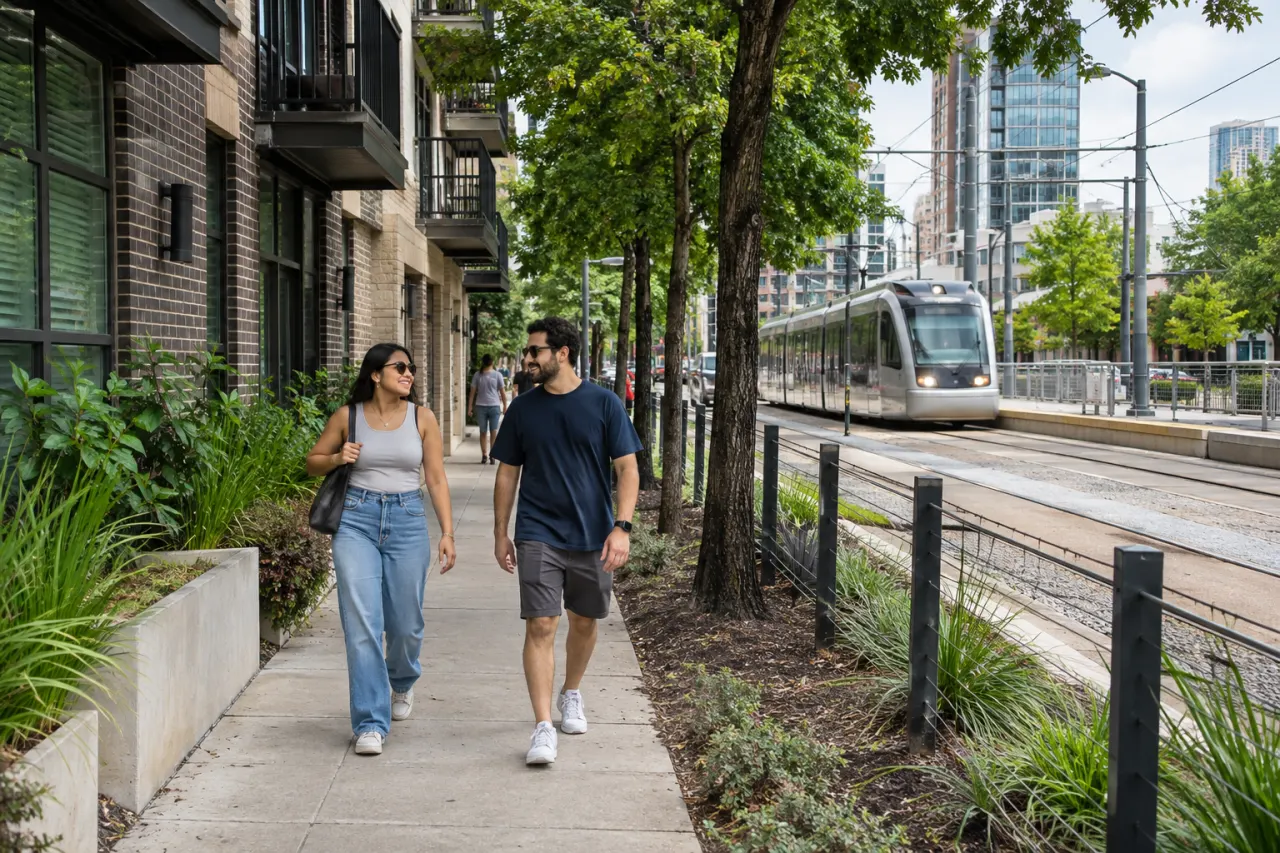
Renting in Houston without a car can work when your home, job, groceries, and regular appointments fit a useful transit corridor. Start with the destination you need most often, then work backward to suitable apartments. A neighborhood's reputation for walkability matters less than the routes and crossings outside the exact building.
Downtown, Midtown, EaDo, the Museum District, the Medical Center, Montrose, and parts of the Heights can be worth investigating for different reasons. None is universally convenient without a car. One block may offer a straightforward walk to a useful stop while another introduces an uncomfortable crossing or a transfer that makes the commute impractical.
What makes an apartment workable without a car?
A good candidate combines several things: a manageable walk to transit, service that runs when you need it, essentials nearby, and a budget for exceptions. You should be able to describe a normal workday and weekend without assuming every trip will go perfectly.
Before browsing, write down your five most common destinations. Include the exact work entrance, your usual grocery store, pharmacy, and any regular care responsibilities. Add the times you need to arrive and leave. Someone who works daytime hours Downtown has different options from a hospital worker whose shift ends after midnight.
If one essential destination requires an unreliable journey, decide whether an occasional ride is affordable or whether you need a different location. Saving money on rent is less helpful if the arrangement repeatedly makes you late or forces expensive trips.
Understand Houston's rail and bus network
METRO operates the Red, Green, and Purple METRORail lines, alongside a wider bus network. Rail can be useful for trips along its corridors and through central Houston, but it does not reach every employment center or apartment district. Bus routes may make the more useful connection for your particular address.
Use METRO's current system map and official trip planning resources rather than an old neighborhood guide. Look at travel time in each direction, transfer locations, service span, and the departure interval at the time you actually travel. Check service alerts before a test trip.
A short scheduled ride can still create a long door-to-door journey if the walk, wait, or transfer is difficult. Record the whole trip. Include time to cross the street, reach the platform, wait for the connection, and walk from the final stop to the correct entrance.
Areas to investigate for different routines
Downtown: useful for some central destinations
Downtown may suit someone whose job or study destination is nearby or accessible through the central rail network. Some apartment locations offer a short commute and several transit choices. However, grocery access, evening routines, building entrances, and weekend service still need checking.
Walk the exact route from the apartment to your usual errands. A convenient office commute does not automatically provide an easy weekly grocery shop. Ask where deliveries are accepted and whether nearby stores meet your budget rather than merely counting them on a map.
Midtown: compare the station and the surrounding blocks
Midtown can be worth a look when a Red Line connection supports your routine. The apartment's relationship to a station matters more than whether the listing uses “Midtown” in its description. Measure the real walking route and identify the crossings you will use.
Also visit at the hours when you expect to be home. Restaurants and nightlife may be welcome conveniences or a source of noise, depending on the building. Inspect the unit's windows and bedroom position rather than assuming every property shares the same conditions.
EaDo and East Downtown: verify the specific connection
EaDo and nearby eastern areas may work for certain Downtown and rail-connected trips. Check the relevant Green or Purple Line stations and transfers for your destination. Rail infrastructure nearby is useful only when the direction and operating hours match your needs.
Inspect sidewalk continuity and how you reach groceries or other essentials. Construction, wide roads, and event-day activity can affect individual routes. An apartment that looks close on a map may require a longer or less comfortable walk than expected.
Museum District and Medical Center: useful destinations, different entrances
The Museum District and Medical Center can be practical starting points for some Red Line journeys and nearby jobs. Large campuses complicate distance estimates: the nearest stop may be convenient to the district but far from your building, department, or shift entrance.
For a hospital or campus job, ask about shuttles, employee entrances, and after-hours access. Test the final walk in work clothes and allow time for the building's internal routes. If the return journey happens late, check the actual service available then.
Montrose: bus routes and errands deserve close attention
Montrose may offer useful local shops and bus connections for some renters, but convenience varies considerably within the area. Do not assume a rail commute simply because the neighborhood is central. Map the route from the exact apartment to your destination.
A useful grocery store within walking distance can make daily life easier even when commuting requires a bus. Compare shaded walking routes, crossings, and practical carrying distance. The nearest store may not be where you want to buy a full week's food.
Parts of the Heights: distinguish a pleasant outing from a daily transport plan
Some parts of the Heights offer local errands, paths, and bus access that may suit particular households. Other addresses can leave important destinations difficult to reach without a vehicle. A weekend walk through a commercial strip does not establish that an apartment supports a car-free working week.
Examine the commute and essentials separately. If cycling is part of the plan, inspect how a path connects to your building and workplace rather than assuming a nearby trail solves the whole trip.
Use a simple apartment comparison sheet
| Question | What to record |
|---|---|
| Work commute | Door-to-door time in both directions at your actual hours |
| Transit service | Route, direction, service span, frequency, and transfers |
| Groceries | Real walking route, carrying distance, and affordable alternatives |
| Walking conditions | Sidewalk gaps, crossings, shade, lighting, and construction |
| Backup travel | Estimated occasional ride costs and another usable route |
| Building access | Bike storage, deliveries, visitor access, and unnecessary parking fees |
Use the same sheet for every viewing. It makes trade-offs visible and prevents a beautiful apartment from distracting you from a journey that will dominate your week.
Solve the last-mile problem before signing
The last mile is the portion between transit and your actual destination. It can be a short walk, a building shuttle, a bicycle segment, or the part that makes the entire plan fail. Do not evaluate it only through straight-line distance.
Check whether the stop is on the side of the road you need. Look for marked crossings and functioning signals. Inspect access after rain and consider what happens if a sidewalk is blocked. A route should be manageable while carrying groceries, not just during a leisurely viewing.
If you have mobility needs, confirm stop and station accessibility, building entrances, elevators, and any planned disruptions with the relevant providers. An accessible station does not establish that the full route from your front door is accessible.
Plan around summer heat and rain
A walk that feels easy on a mild day may be much less appealing during Houston's hot, humid weather. Shade, waiting conditions, and the distance between a stop and your building matter. Carry water and allow time to arrive without rushing.
Ask yourself what you will do during heavy rain or a service disruption. A covered stop is helpful, but so is a building where you can wait comfortably for a ride. Keep essential work items protected and consider whether your employer offers somewhere to change or store a spare shirt.
The aim is a repeatable routine, not proving that every trip can be walked. Occasional paid alternatives may be a sensible part of living without a car if you include them honestly in the budget.
Budget for ride-share, delivery, and occasional longer trips
Compare rent plus transportation, rather than rent alone. Add transit fares, occasional ride-share, grocery delivery if you expect to use it, and trips that the network does not serve conveniently. Check live estimates for your likely travel times; prices can vary.
For example, a cheaper apartment requiring several paid rides each week may cost more overall than one beside a useful route. Conversely, paying a premium for rail access may not help if your job is in a different corridor. Calculate around your actual destinations.
Keep some contingency in the budget for unusually late work, illness, severe weather, or a missed connection. If your plan depends on never needing an alternative, it is probably too tight.
Consider bicycles as part of a route
A bicycle may extend access to transit and errands, but assess your comfort, route conditions, storage, and weather before relying on one. Check where protected facilities begin and end, how intersections work, and where you can securely lock the bike.
Ask the building about storage rules and whether bicycles can be brought inside. Confirm current transit bicycle policies if you plan to combine modes. Practice the whole journey before making it your normal commute, including the final approach to work.
Electric bicycles also introduce charging and storage questions. Check the lease and building rules, use appropriate equipment, and avoid choosing an apartment on the assumption that any bicycle arrangement will be accepted.
A viewing checklist for renters without a car
- Travel to the viewing using your planned everyday route.
- Walk from the stop to the apartment entrance.
- Check the return journey at your real departure time.
- Visit an affordable grocery store and consider carrying bags home.
- Confirm weekend and late-evening options if needed.
- Ask whether parking charges are optional or mandatory.
- Inspect bike storage and delivery arrangements.
- Price two or three likely backup trips.
- Check the lease's full recurring costs.
- Recheck the route before paying or signing.
Choose a location that supports your actual week
Car-free renting in Houston is an address-and-destination decision. A smaller apartment beside a useful route may offer better value than a larger place with awkward connections. Someone else may reasonably choose the opposite arrangement because their work and family destinations differ.
Start with Houston rental listings on DealsNonStop, then verify each candidate through current transit planning and a real visit. For broader preparation, What to Know Before Moving to Houston covers housing fees, flood research, utilities, and commute planning. A workable home is one you can reach, leave, and live around comfortably on an ordinary day.
If a convenient address means choosing a smaller unit, Houston Studio vs One-Bedroom Rent can help you compare usable space with transportation savings.
Sources and further reading
Transit resources checked November 7, 2026: METRORail service information, METRO system map, and METRO trip planning. Neighborhood examples are starting points for address-level investigation, not guarantees of service or walkability.