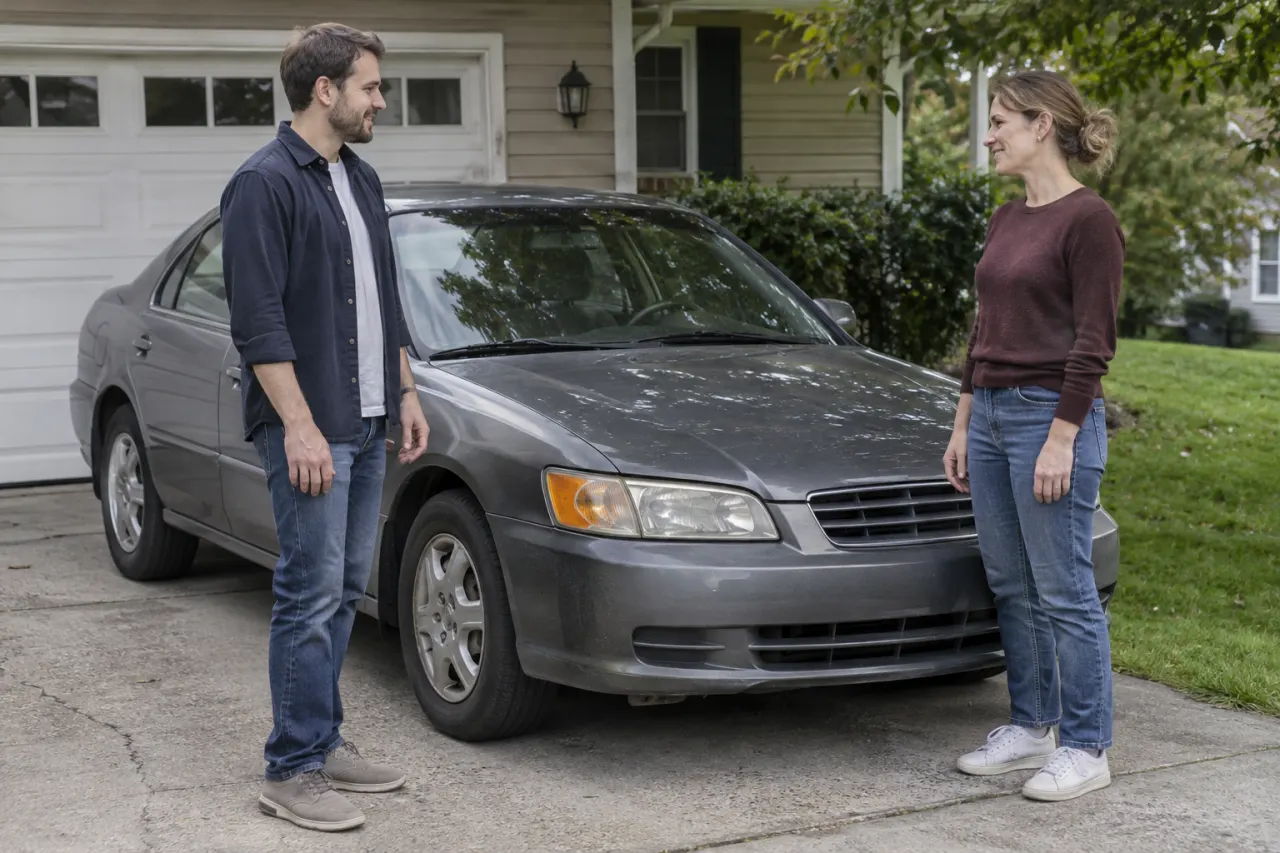
Before visiting a used car, ask for the VIN, title status, current mileage, ownership history, known problems, and permission for an independent inspection. Those answers help you decide whether the car deserves a viewing. At the viewing, use the seller's answers as leads to verify against documents and the vehicle itself.
A seller does not need perfect knowledge of every previous owner. Honest uncertainty is different from contradictions, pressure, or refusal to provide basic information. Keep notes, request important details in writing, and avoid treating a friendly conversation as proof that the purchase is sound.
Start with ownership and the reason for selling
“Why are you selling, and how long have you owned it?”
Listen for a specific explanation, then compare it with the timeline. A short ownership period is not automatically a problem, but it makes purchase records, repairs, and the reason for another sale more relevant. Ask whether the vehicle was a daily driver, spare car, work vehicle, or recent project.
Follow up with: “Is the title in your name?” If someone is selling for a relative or another owner, establish their authority and the required transfer process before traveling. Do not assume possession of the keys proves the right to sell the car.
“What is the current mileage?”
Ask for a recent odometer photograph and whether the display or instrument cluster has been replaced. Compare mileage against service invoices and history records later. A small difference from an older listing can be ordinary use; a lower current reading than a dated record needs an explanation.
Mileage is only one part of condition. How Many Miles Is Too Many for a Used Car? explains why maintenance, usage, and inspection findings matter alongside the number.
Ask about accidents, floods, and the title separately
“Has it had any collision damage or body repair?”
Avoid stopping at “Has it been in an accident?” Ask what was damaged, when, who repaired it, and whether invoices or photographs exist. A replaced bumper and repaired structural damage raise different questions. Clarify whether airbags deployed and whether restraint systems or driver-assistance equipment required work.
If the seller says they do not know, record that uncertainty. A vehicle history report may help, but it does not catch every incident or establish the quality of a repair. An independent inspection remains important even when the paperwork looks reassuring.
“Has it ever had flood or water intrusion?”
Ask about water in the cabin, trunk, engine compartment, or electrical systems. Also ask whether carpets, seats, modules, or wiring have been replaced. A leak from a window is different from submersion, but both deserve explanation and inspection.
Use How to Tell If a Used Car Was Flood-Damaged to organize observations. Odor, staining, or corrosion can have several explanations; do not diagnose the entire history from one clue.
“Is the title clean, salvage, rebuilt, or otherwise branded?”
Request the exact wording rather than accepting “clear” as an answer. Sellers sometimes use “clear” to mean no loan while buyers understand it to mean no title brand. Ask about both separately.
State terminology differs. Verify the actual document and title history, then check registration requirements where you will use the vehicle. A current title is useful evidence, but it does not by itself prove that the car has never been damaged.
Establish whether money is still owed
Ask: “Is there a lien, and how will it be released?” If financing remains, request a clear process involving the lender and the appropriate title authority. Confirm the payoff and transfer arrangements through independently obtained contact details.
Do not improvise a handover where you pay the seller and simply hope a title arrives later. A legitimate outstanding loan can be manageable, but the process must protect both sides and comply with local requirements.
If the seller cannot explain who holds the title or how the lien will be cleared, postpone the deal. A discount does not compensate for uncertainty over whether you can receive valid ownership documents.
Ask for maintenance evidence
“What maintenance records do you have?”
Request invoices rather than only a stamped book or verbal summary. Useful records identify the date, mileage, work performed, and vehicle. Ask whether the seller can show routine oil service, cooling-system work, brake service, and any model-specific scheduled maintenance.
Compare the records with the manufacturer's schedule for that exact model and powertrain. Missing paperwork does not prove neglect, but it changes what you can verify and which upcoming work you should budget for.
“What major repairs have been done?”
Ask about engine, transmission, cooling, suspension, air conditioning, and electrical repairs. Who performed the work? Was it a repair, used replacement, rebuilt component, or software update? Is any warranty transferable, and what does it actually cover?
A recent major repair can be positive if it is well documented and successful. It can also require follow-up. Ask whether symptoms remain and whether the car has been driven enough since the work to establish normal operation.
Make the mechanical questions specific
“Does it use oil or coolant between services?”
Ask how often fluids are checked and whether the seller adds any between scheduled services. “It runs fine” does not answer the question. Request the approximate amount and interval if top-ups are needed, then discuss the answer with your mechanic.
“Are there transmission problems?”
Ask about delayed engagement, unusual shifting, shuddering, slipping, or difficulty selecting a gear. For a manual, ask about clutch replacement and gear engagement. These questions identify concerns to investigate; a symptom alone does not establish a particular failure.
“Are any warning lights on, intermittent, or recently cleared?”
Ask about engine, airbag, ABS, tire-pressure, charging, and hybrid-system warnings where relevant. Request an explanation and repair paperwork. A dashboard without illuminated warnings is useful but cannot establish that all systems are healthy.
Check wear items and recent spending
Ask when the tires and brakes were last replaced and whether the car has uneven tire wear, vibrations, or pulling. Request invoices and look at the actual components during the inspection. Tires can age even if their tread looks acceptable.
Ask which maintenance is due soon and whether the seller has a recent inspection report or repair estimate. A seller may be moving on because of ordinary upcoming expenses. Those costs matter to your budget even if they do not indicate dishonesty.
Also ask about the battery, air conditioning, windows, locks, and infotainment. Small faults can add inconvenience and expense, especially when several are present. Used Car Buying Checklist can help you test features systematically.
Keys, modifications, and included equipment
“How many working keys come with it?” is easy to forget. Confirm that each key starts the vehicle and that remote functions operate. Replacement or programming costs vary, so obtain a quote if only one key is available.
Ask whether the car has modifications to the engine software, exhaust, suspension, lighting, wheels, or security systems. Request original parts if included and ask who installed the changes. Modifications can affect servicing, insurance, emissions compliance, and your interest in the vehicle.
Confirm what remains with the sale: spare wheel or repair kit, charging cables for a plug-in, manuals, cargo covers, and any accessories shown in the listing. Put material promises into the sale documentation rather than relying on photographs alone.
Inspection and test-drive questions
Ask: “May I arrange an independent pre-purchase inspection with a shop I choose?” Agree on logistics before arriving, including timing, distance, and who pays. A seller's own inspection can provide information but does not replace independent evaluation.
Request a cold start if practical, and ask not to have the engine warmed before you arrive. Confirm that a legal, insured test drive can be arranged and that the route includes ordinary low-speed and higher-speed conditions where appropriate.
If a seller refuses any reasonable independent inspection, you may decide the uncertainty is too large. You do not need to prove the vehicle has a defect to decline a transaction that cannot be checked adequately.
Price and negotiation
Ask: “How did you set the asking price, and is there room to discuss it after inspection?” Compare similar vehicles with comparable title history, mileage, equipment, and condition. A clean-title asking price is not an appropriate benchmark for every branded-title car.
Avoid negotiating from an invented repair diagnosis. Use documented needs, inspection findings, and real alternatives. Keep your total budget separate from the asking price, including taxes, registration, insurance, and immediate maintenance.
Before any deposit, agree on its terms in writing and verify the seller and vehicle. How to Avoid Used-Car Deposit Scams explains why pressure to send money before basic checks is a reason to stop and reassess.
Questions to ask before you even go see the car
Send a short message covering the essentials:
- What is the VIN and current mileage?
- Is the title in your name, and what exact title status does it show?
- Is there a lien or any transfer obstacle?
- How long have you owned it, and why are you selling?
- What accidents, water damage, major repairs, or known faults can you disclose?
- Are warning lights on or recently cleared?
- Can you provide service records and recent photographs?
- Will you allow an independent inspection and a properly arranged test drive?
- How many keys are included?
- Is the asking price negotiable after inspection?
Turn answers into a decision
You are looking for consistency between the listing, the seller's account, documents, and inspection findings. Some unanswered questions may be manageable with evidence or a lower offer. Others, especially identity, title, or inspection obstacles, can justify walking away.
When browsing used-car listings on DealsNonStop, keep this checklist beside your shortlist. Ask the important questions early, then spend your viewing time verifying the strongest candidates rather than discovering basic deal-breaking details after you have already traveled.
Next, plan a proper test drive and check the VIN before agreeing to buy.
Sources and further reading
Research checked November 7, 2026: FTC used-car guidance for history and independent-inspection principles, and NMVTIS consumer information for title-history resources and their limits. Transfer procedures should be confirmed with the relevant state authority and lender.