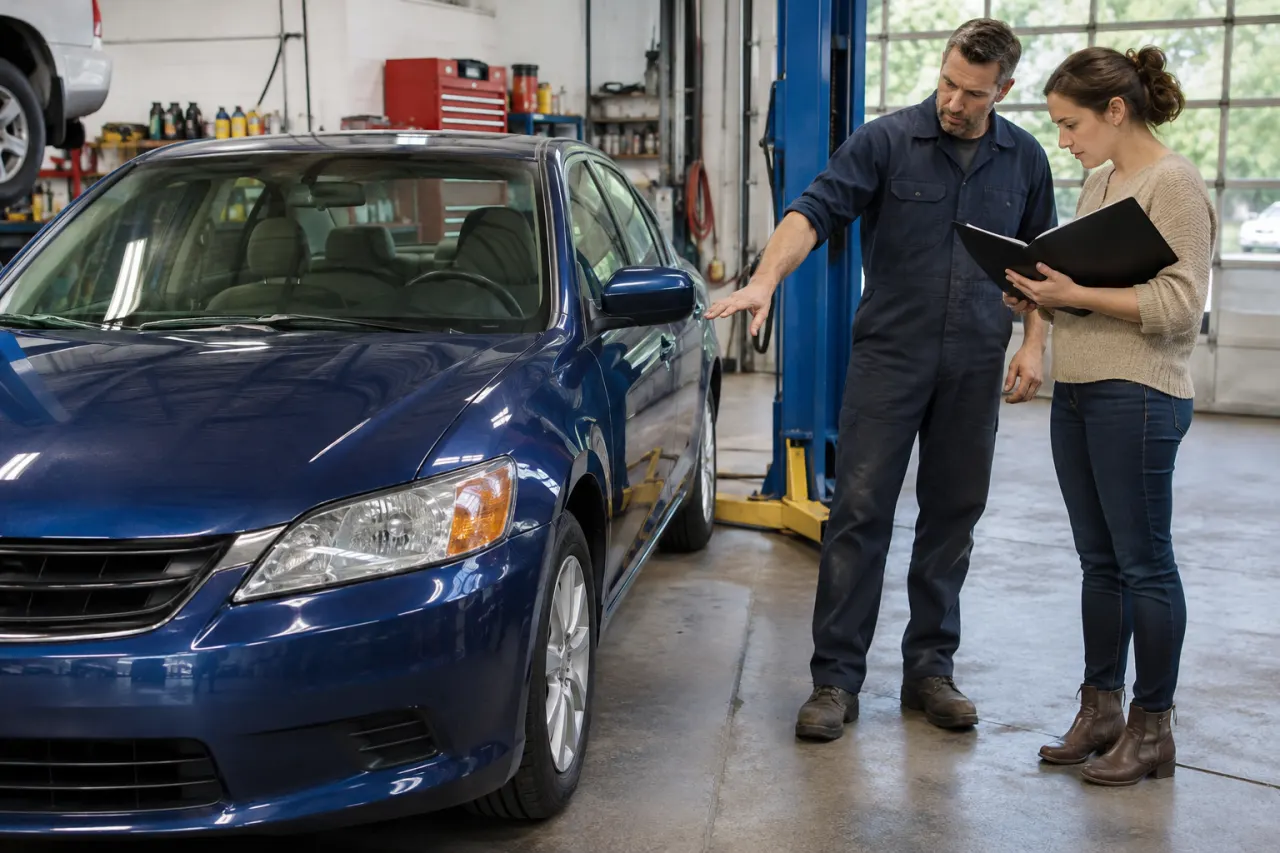
A rebuilt-title car may be worth considering when the prior damage is well documented, repairs can be independently evaluated, insurance and registration are straightforward for your situation, and the price leaves room for the remaining risk. It is usually a poor fit when you need predictable transport but cannot verify the repairs or absorb unexpected costs.
The lower asking price is only the beginning of the comparison. A rebuilt vehicle can be harder to finance, insure, and resell, depending on the car and provider. Evaluate the specific vehicle rather than assuming that every rebuilt car is dangerous or that a completed title process guarantees excellent repairs.
What does rebuilt title mean?
A rebuilt title generally indicates that a vehicle previously classified as salvage has completed the issuing state's required process for a road-eligible title status. The exact terminology and process vary by state. “Rebuilt,” “rebuilt salvage,” and “reconstructed” should be checked against the actual state's definitions.
The designation records history; it does not erase the earlier loss. It also does not mean every part of the car has been renewed. Ask what was damaged and what work was performed rather than treating “rebuilt” as a mechanical description of the entire vehicle.
A government inspection or paperwork process may have a specific scope. Confirm what was required and what it establishes. You still need independent evaluation of repair quality, safety-related systems, and normal wear.
How does salvage differ from rebuilt?
Salvage generally describes a vehicle classified under a state's loss or damage rules before the required return-to-road process has been completed. Such a vehicle may not be eligible for ordinary road use. Some classifications, including certain nonrepairable statuses, may not be eligible for rebuilding at all.
Rebuilt generally describes a later status after applicable requirements have been met. Requirements can involve repairs, documentation, identity checks, inspections, and fees, depending on the jurisdiction and vehicle. Do not assume a seller's description is accurate without reading the documents.
For the underlying terms, see What Does a Salvage Title Mean?. If the car comes from another state, ask the state where you will register it how the existing documents will be treated before you place a deposit.
Clean title vs rebuilt title
| Factor | Clean Title | Rebuilt Title |
|---|---|---|
| Purchase price | Usually higher for comparable condition | Often lower, with wide variation |
| History | Typically simpler, though damage can be unreported | Prior salvage or major loss history to investigate |
| Financing | Usually easier to arrange | May be harder or unavailable from some lenders |
| Insurance | Typically easier to arrange | Coverage or valuation may be limited |
| Resale | Typically stronger buyer demand | Usually weaker demand and more questions |
| Inspection need | Important | Especially important, including prior repairs |
These comparisons are tendencies, not guarantees. A neglected clean-title car can be worse mechanically than a carefully repaired vehicle. The rebuilt history nevertheless adds questions that a buyer needs to answer and price appropriately.
The potential benefit: a lower entry price
A rebuilt car may offer access to a vehicle you could not comfortably afford with a simpler history. For a knowledgeable buyer who can assess documents and use suitable specialists, that difference can be meaningful.
However, compare the car with genuine alternatives rather than a single optimistic clean-title listing. Include age, mileage, specification, maintenance, damage type, and repair quality. A large advertised discount is not evidence of value if the reference price is unrealistic.
Avoid applying one universal percentage reduction. The appropriate price depends on facts specific to the vehicle and your local market. If the evidence is too weak to estimate the risk reasonably, a lower number does not solve the underlying problem.
Find out why it became salvage
Ask for the original loss event, date, mileage, and available documents. Collision, flood, fire, theft recovery, and other losses raise different concerns. “It was only an insurance write-off” does not explain the damage.
Request pre-repair photographs and the original estimate where available, then compare them with the final repair invoice. Initial estimates can change after disassembly, so establish what work was actually completed. Ask about parts sources, the repairing shop, and any remaining issues.
An older vehicle may reach a loss threshold because of its value relative to repair costs, but that possibility should not be assumed. The evidence needs to support the seller's explanation for this particular car.
Verify the VIN and title history
Compare the VIN on the vehicle with the title, registration, repair invoices, and reports. Look for inconsistent dates, unexplained mileage changes, or descriptions that do not match the physical car. Resolve discrepancies before discussing a payment arrangement.
Use How to Check a Used Car VIN Before Buying for a sequence covering decoding, title history, and recalls. Obtain reports independently and understand their coverage. No report captures every event or confirms that repairs were done correctly.
Confirm who owns the vehicle and whether a lien exists. A rebuilt brand and an outstanding loan are separate issues. The transaction still needs a valid transfer process, appropriate documents, and lender involvement when required.
Repair documentation should answer specific questions
A useful file identifies the VIN, dates, work performed, parts, repairer, and any relevant testing or calibration. Ask which structural, suspension, electrical, and restraint components were affected. A generic receipt for “body work” leaves more uncertainty than an itemized record.
Before-and-after photographs can help establish the visible extent of the damage and the repair sequence. They do not prove hidden work was completed. Compare them with invoices and the inspector's findings rather than relying on pictures alone.
Ask whether any repair warranty remains and whether it transfers. Read exclusions and claim procedures. A warranty may provide limited support, but it does not replace evidence about the work or guarantee that a later problem will be covered.
Arrange an independent inspection tailored to the history
Tell the shop that the vehicle has a rebuilt title and explain the loss type before booking. Ask whether it can assess the previous repairs or whether a body, structural, electrical, or hybrid specialist is also needed.
For a collision-repaired vehicle, discuss panel fit, structural measurements where appropriate, suspension geometry, restraints, corrosion protection, and driver-assistance calibration. A general service inspection may not cover all of these areas. Get the scope and limitations in writing.
For flood or fire history, ask what can be checked and what remains uncertain in protected or inaccessible areas. Some problems may emerge later despite a careful inspection. Decide whether that residual uncertainty fits your budget and need for dependable transport.
Electrical and structural concerns can be hard to price
A car can look excellent while hiding poor connections, water-related corrosion, incomplete repairs, or damage that was not corrected properly. Normal operation during a short visit does not establish long-term reliability.
Avoid diagnosing the whole vehicle from a single symptom, but do not dismiss repeated warnings or inconsistent behavior. Ask a specialist to investigate and obtain an estimate where a problem can be defined. If essential systems cannot be verified, consider another vehicle.
Similarly, a straight test drive is not a structural certificate. Alignment, body measurements, repair records, and inspection findings provide different kinds of evidence. Use them together rather than selecting whichever result supports the purchase you want to make.
Confirm insurance before paying
Give the insurer the exact VIN and title classification. Ask which coverages are available, whether any inspection is required, and how value would be determined after a claim. Coverage options can differ between insurers and circumstances.
Do not assume that an online quote based only on the model is a firm answer for a rebuilt vehicle. Ask for confirmation that the title history has been considered. If you need collision or comprehensive coverage, check those explicitly rather than only liability.
If a loan is involved, compare the insurer's offer with the lender's requirements. A policy that is acceptable for your own needs may still fail a lender's conditions. Resolve both sides before committing to the car.
Financing and resale can change the value calculation
Some lenders may decline branded-title vehicles or impose different terms. Confirm eligibility before assuming a preapproval will apply. Compare the total cost of finance, required down payment, and insurance obligations with a simpler-history alternative.
For resale, expect a narrower pool of buyers and more questions. Some buyers or businesses may not want the vehicle regardless of documentation. Good records can make the history easier to evaluate, but they do not remove it.
Think about your time horizon. If you may relocate, change jobs, or need to sell quickly, reduced flexibility has a cost. A lower purchase price is less attractive when the ownership plan depends on an easy resale at short notice.
Calculate an honest total budget
Add purchase price, taxes and registration, inspections, transport if required, immediate maintenance, insurance, financing, and a contingency reserve. Separate known costs from uncertain ones. Do not spend the whole budget on the purchase and assume the discount will pay for problems later.
Compare that total with another car you could actually buy. A less desirable model with a simpler documented history may be a better solution for daily transport than a more desirable rebuilt vehicle with unresolved questions.
Use Used Car Buying Checklist to cover ordinary condition as well as the previous loss. For collision-specific considerations, Should You Buy a Car With an Accident History? explains how severity and repair evidence affect the decision.
A decision checklist before committing
- Verify the exact title status and registration eligibility.
- Match the VIN across the car and documents.
- Establish the loss type and original damage.
- Obtain available invoices and before-and-after photographs.
- Arrange independent inspection with the necessary expertise.
- Identify what remains inaccessible or uncertain.
- Confirm insurance and financing for this vehicle.
- Compare the complete cost with realistic alternatives.
- Keep a reserve and consider future resale difficulty.
A rebuilt car can be worth investigating for a buyer equipped to evaluate the history and accept the remaining uncertainty. It is not automatically a bargain. When browsing used cars on DealsNonStop, ask about title status early and choose a purchase whose evidence and total costs fit your needs, rather than letting a low headline price decide for you.
Sources and further reading
Checked November 7, 2026: TxDMV rebuilt vehicle terminology, TxDMV salvage brands, and NMVTIS consumer resources. Verify current requirements with the relevant state agency and obtain individual insurer and lender decisions.