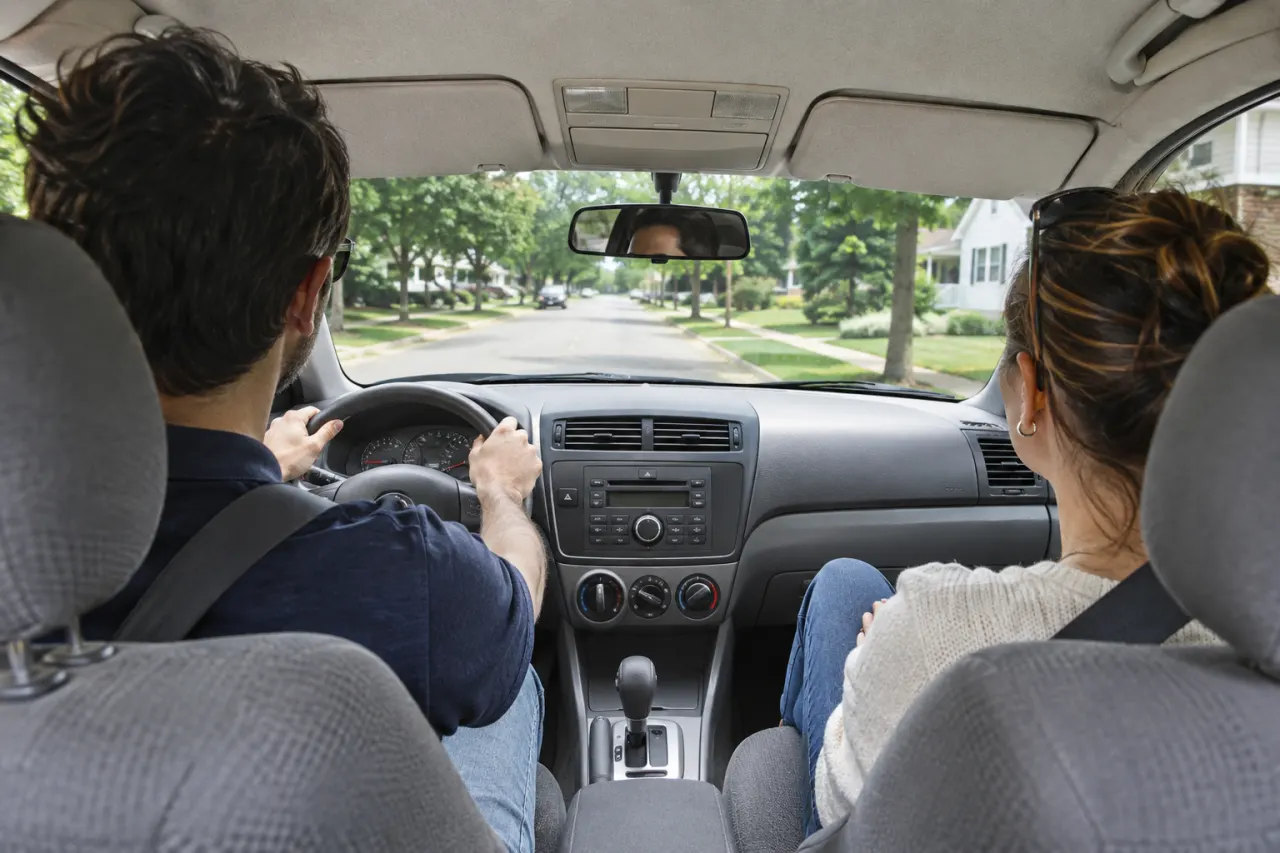
A useful used-car test drive starts before the engine runs, follows a planned route through several normal driving conditions, and ends with another inspection while the vehicle is warm. Take notes about what you observe rather than trying to diagnose every noise. The drive helps you decide whether to proceed to an independent inspection; it does not replace one.
Ask for enough time to check the car calmly. Confirm the seller's permission, licensing and insurance arrangements, and any restrictions before you leave. If the car has an obvious safety concern, a serious warning message, or questionable road legality, resolve that before driving it.
Agree on the route and conditions first
Choose a route with ordinary residential streets, a suitable faster road where legal and practical, several turns, and somewhere to park. Avoid setting off into unfamiliar traffic while also learning the controls. Ask the seller to explain unusual features before you move.
The goal is normal use, not a performance test. Do not accelerate aggressively, make abrupt maneuvers, or try to reproduce a fault in a way that puts people at risk. If a condition cannot be tested safely during the viewing, tell the inspecting mechanic what remains unchecked.
Bring your usual glasses and wear shoes that allow normal pedal control. If another household member will regularly drive the vehicle, arrange a separate check of their seating and visibility. A mechanically sound car can still be a poor fit for the person using it.
Before driving: inspect the car while parked
Walk around and look at tires, obvious fluid leaks, lamps, glass, and body damage. Check that the vehicle's identity matches the listing and paperwork. Do not crawl underneath an unsupported vehicle or touch hot or moving components.
Look for anything that would make a drive inappropriate, such as a visibly damaged tire, strong fuel smell, or fluid loss that has not been explained. You are not required to continue because a viewing has been arranged. Ask a qualified person to assess concerns first.
Use Used Car Buying Checklist for the broader inspection and Questions to Ask a Used Car Seller to organize the history discussion before you concentrate on driving behavior.
Request a cold start
If practical, ask the seller not to warm the engine before you arrive. A first start can reveal behavior that is less apparent once the vehicle is warm. Confirm whether it has already been running and record that limitation if you cannot observe a cold start.
Listen as it starts and settles into idle. Notice prolonged cranking, unusual shaking, persistent smoke, or unexpected mechanical sounds. A brief noise or vapor can have different explanations depending on temperature and design; describe what happened and ask your mechanic rather than assigning a diagnosis.
Watch the dashboard's startup checks. Relevant warning indicators should behave as the manufacturer describes, and unresolved messages deserve explanation. Ask about warning lights that remain on, return during the drive, or have recently been cleared.
Set up the seat, controls, and visibility
Adjust the seat, steering wheel, mirrors, and head restraint before moving. Check your view at intersections and over your shoulders. Make sure you can reach the pedals comfortably without stretching or sitting too close to the wheel.
Try essential controls while parked: indicators, lights, wipers, washers, ventilation, demisting, and the parking brake. Confirm that the seat belt latches and retracts normally. Test air conditioning and heating long enough to observe their operation, while recognizing that weather can limit what you can assess.
Check the camera, sensors, and driver-assistance settings if fitted. Treat them as aids, not substitutes for looking. Ask whether windscreen replacement, collision repair, or other work required calibration and whether records are available.
Start with low-speed driving
Leave the parking area gently and pay attention to pedal response, steering effort, and how the transmission engages. At low speed, check whether the car moves smoothly and whether unusual noises appear over normal surface changes.
Make ordinary turns in both directions where permitted. Notice any binding, repeated clicking, heavy steering, or unexpected resistance. Do not hold the steering against its stop or perform tight circles in traffic just to provoke a sound.
Use a quiet legal parking area to check maneuverability. Reverse, park, and move forward again with the seller's permission. Confirm that you can judge the vehicle's corners and that its size suits the spaces you normally use.
Acceleration and transmission behavior
Accelerate progressively into the flow of traffic. Note hesitation, surging, shuddering, warning messages, or power delivery that feels inconsistent. Compare behavior during gentle and moderately stronger acceleration where conditions allow, without exceeding limits.
For an automatic, observe engagement from park into drive and reverse while stationary with the brake applied. During the drive, note shifts that feel delayed, harsh, or inconsistent. Some transmission types behave differently from a conventional automatic, so ask about the correct expectations for that model.
A continuously variable transmission may maintain engine speed differently from a stepped automatic. That characteristic alone does not establish a fault. Unexplained slipping sensations, unusual noises, or warning messages still deserve specialist evaluation.
Braking: check ordinary stops
On a clear road, make a few normal stops with plenty of space. Pay attention to pedal feel, stopping consistency, pulling, grinding, or vibration. Keep both hands available for control and do not attempt emergency braking on a public road as a buying test.
A soft or sinking pedal, serious pulling, or reduced braking effectiveness is a reason to stop safely and seek help. Do not continue driving to gather more evidence of a possible brake problem. Ask the seller to arrange appropriate assessment or transport.
Some noise can relate to surface conditions or recent inactivity, but that does not mean it should be dismissed. Record when the sound occurs and have the brakes inspected. Your budget should reflect measured condition and repair estimates, not assumptions.
Steering, suspension, and higher-speed behavior
Notice whether the vehicle tracks predictably and whether the wheel sits reasonably centered on a suitable road. Road camber, wind, tires, and alignment can all influence what you feel. Do not release the steering wheel to test straight-line travel.
Listen over ordinary bumps for repeated clunks, rattles, or harsh impacts. Compare how the car feels on smooth and uneven pavement. One noise cannot identify a specific worn component, and a quiet cabin does not prove that everything underneath is sound.
If a highway or faster-road segment is appropriate, assess merging, cruising, wind noise, and vibration at legal speeds. Maintain normal following distance. If the car becomes unstable or develops a significant vibration, leave the road safely rather than attempting higher speeds to investigate.
What to listen and feel for
| Observation | Useful detail to record |
|---|---|
| Clunk | Happens over bumps, during turns, or when changing direction |
| Grinding | Appears during braking, shifting, or continuous motion |
| Whine | Changes with road speed, engine speed, or steering input |
| Vibration | Felt in the wheel, seat, pedals, or whole vehicle |
| Rattle | Occurs on rough roads, at idle, or with certain accessories |
These notes help a mechanic reproduce the concern. Avoid declaring a transmission, wheel bearing, or suspension failure from a single sound. Several systems can create similar symptoms, and an inspection may be needed to distinguish them.
Extra checks for manual cars
Only drive a manual if you can operate it confidently. Check that the clutch and gear lever are comfortable and that gears engage normally during ordinary driving. Note difficulty selecting gears, grinding, unusual pedal behavior, or engine speed rising without the expected acceleration.
Do not perform deliberate clutch abuse, high-gear stall tests, or aggressive launches. Such tests can damage someone else's car and are not necessary for a sensible viewing. If clutch condition is a concern, ask the inspecting shop for an appropriate assessment.
Ask about clutch replacement, transmission service, and modifications. A recent replacement is most helpful when invoices identify the parts and work performed. Factor likely maintenance into your offer after obtaining a professional estimate.
Extra checks for hybrids and plug-in vehicles
Hybrid starting and low-speed behavior may differ from a conventional car because the engine can stop and restart automatically. Confirm the manufacturer's normal operating indications so you know when the vehicle is ready to move even if the engine is quiet.
Observe transitions between operating modes, warning messages, climate operation, and braking feel. Regenerative braking may feel different from a car you know. A short drive or dashboard battery graphic does not establish the high-voltage battery's health.
For a plug-in, ask about charging equipment and arrange a charging demonstration where practical. Request a specialist inspection of battery condition and relevant systems if those findings are important to the purchase. Do not touch high-voltage components or orange cables.
After the drive: inspect again while warm
Park safely and let the seller know what you noticed. Check for new warning lights, abnormal temperature indications, strong smells, or visible leaks without reaching into hot areas. Air-conditioning condensation can be normal; unexplained fluid still needs identification rather than guesswork.
Ask whether the engine can be restarted after a short stop. Review your notes while the observations are fresh. If a symptom occurred only once, describe the conditions precisely rather than forgetting it because the rest of the drive felt good.
Do not remove a hot coolant cap. If there is overheating, a fuel smell, smoke, or another serious concern, stop the process and have the vehicle assessed appropriately.
Use the drive to decide the next step
A good test drive answers two questions: does the car suit you, and is it worth further investigation? It cannot verify hidden structural repairs, every electronic system, or all future reliability risks. An independent pre-purchase inspection provides a different layer of information.
Ask for written findings and repair estimates before settling the final price. How to Negotiate the Price of a Used Car explains how to use documented condition and comparable alternatives. When browsing used cars on DealsNonStop, allow time for both a proper drive and inspection so enthusiasm does not rush the decision.
Sources and further reading
Checked November 7, 2026: FTC guidance on independent used-car inspections and NHTSA recall lookup. For control operation and warning-light behavior, use the owner's manual for the exact vehicle.