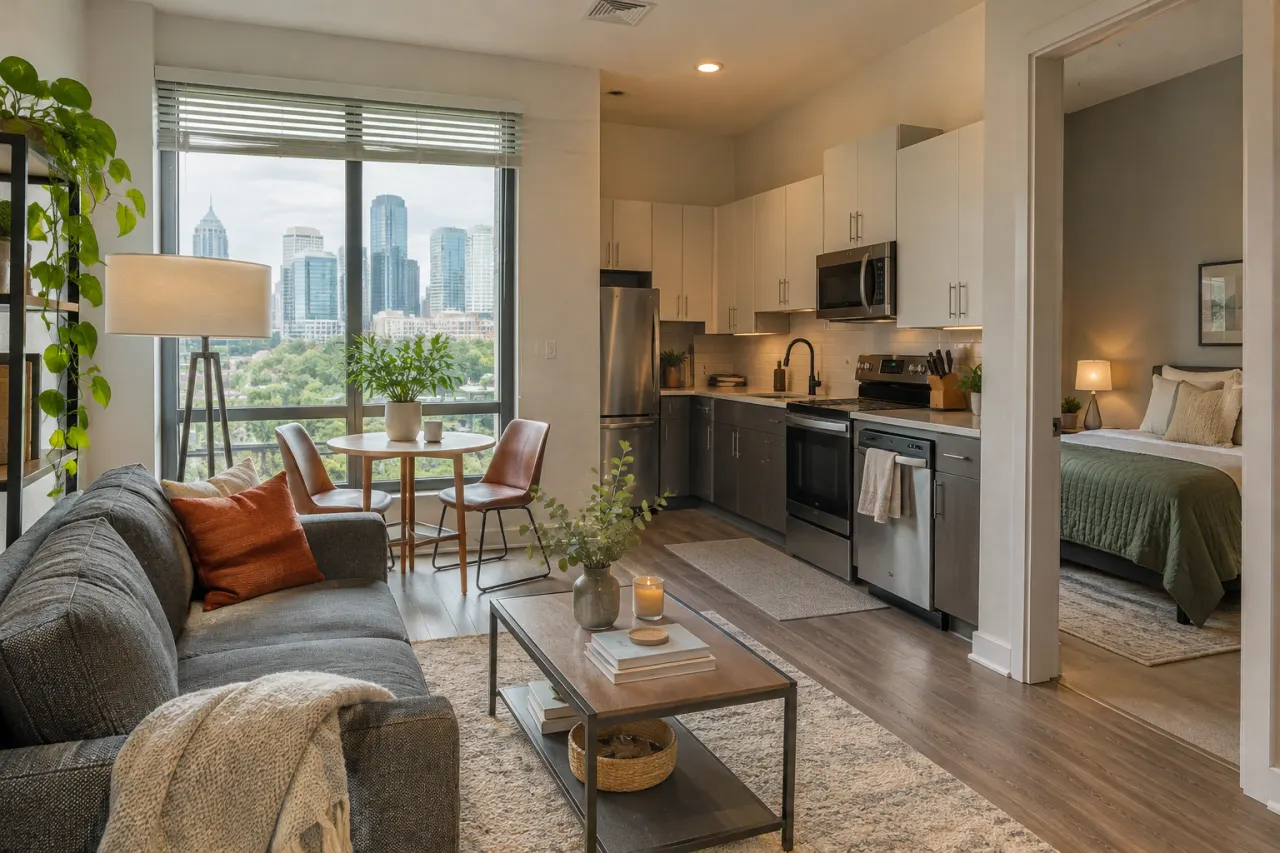
A studio often offers better value when you live alone, need less storage, and can use the rent savings for a location that improves your daily routine. A one-bedroom may be worth the extra cost when a separate sleeping area, shared living arrangement, or work-from-home setup makes a real difference.
The useful comparison is between actual apartments, not just floor-plan labels. A well-designed studio can feel more usable than an awkward one-bedroom. A one-bedroom in an older building can also cost less than a newer studio nearby. Compare total monthly costs, measured space, and the way you will use the home before deciding which is better value.
What is the practical difference?
A studio generally combines sleeping and living areas in one main room, with a separate bathroom. Kitchen layouts vary. A one-bedroom generally provides a separate bedroom, allowing you to close a door between sleeping and living spaces.
Listings do not always describe layouts consistently. An “alcove studio” may offer a recessed sleeping area without a full bedroom. A unit marketed as a one-bedroom may have unusual partitions or a layout that does not provide the privacy you expect. Review the floor plan and tour the exact apartment.
Look at doors, windows, closets, and furniture placement. Square footage alone cannot show whether there is a sensible place for a bed, desk, sofa, and dining area. Photograph or sketch the layout during the viewing so you can compare candidates afterward.
Studio vs one-bedroom at a glance
| Factor | Studio | One-bedroom |
|---|---|---|
| Monthly rent | Often lower in a similar building | Often higher in a comparable unit |
| Space | Usually less total area | Usually more, but layouts vary |
| Privacy | Living and sleeping share space | Bedroom door can separate activities |
| Utilities | May require less cooling, depending on the building | May cost more to condition, depending on efficiency |
| Furniture | Fewer pieces may be enough | More rooms can invite more spending |
| Working from home | Requires careful zoning | Easier to separate work and sleep in some layouts |
| Couples | Requires compatible routines | Often provides more flexibility |
| Storage | Can be limited | May offer additional closets or usable wall space |
These are tendencies rather than promises. Use lease documents and the unit itself to check each category.
Compare monthly rent without inventing an average
Houston rent varies by location, building, condition, amenities, lease term, and current availability. This guide does not use a citywide studio or one-bedroom rent figure because a verified current dataset is not being used. Instead, collect several live quotes for comparable apartments around your target move-in date.
Ask for the base rent, mandatory fees, and concession details in writing. Compare the same lease length and clarify when promotional credits apply. A studio advertised at a lower “effective” rent may still require higher payments during most months of the lease.
Use How Much Does It Cost to Rent an Apartment in Houston? as a total-cost checklist. Note the date of each quote, because the price for a specific available unit can change before you apply.
Work out the full cost difference
Start with recurring housing charges: rent, utilities, internet, parking, pet rent, and required service packages. Then add transportation. A larger apartment farther from work may bring a longer commute, tolls, additional fuel, or more paid rides.
Keep one-time costs separate. Deposits, administrative charges, moving expenses, and new furniture affect the cash needed upfront even if they do not recur. A refundable deposit is different from a nonrefundable fee, and a deposit alternative may carry continuing costs without creating money you get back.
Calculate the difference over the whole lease. If the one-bedroom costs more each month, ask what specific benefit that spending buys: better sleep, usable work space, storage, or a location change. “More space” is most valuable when you can identify how you will use it.
Measure usable space, not just listed square footage
Bring the measurements of your bed, sofa, desk, and largest storage pieces. Mark them on the floor plan and leave space for doors, drawers, and walking routes. A studio with a long uninterrupted wall may be easier to furnish than a larger unit with several awkward corners.
In a one-bedroom, check whether the bedroom can hold your actual furniture while leaving access to the closet. Inspect the living area too. Some plans allocate much of the extra area to circulation rather than the rooms you use most.
Ask whether the advertised floor plan matches the unit being offered. Columns, windows, appliances, and closet locations can vary. Do not buy furniture from a sample diagram before confirming measurements in the actual apartment.
Privacy and sleep can outweigh floor area
A separate bedroom can be useful when one person gets up early or stays awake later. It also provides somewhere to put laundry or personal belongings when guests visit. However, a door alone does not guarantee quiet; wall construction, windows, neighbors, and the position of common areas all matter.
In a studio, consider whether light from the kitchen or a computer would disturb your sleep. Ask yourself where visitors would sit and whether you are comfortable with the bed being part of the same space. Screens and shelves can create visual separation but will not usually isolate sound.
For some solo renters, this trade-off is easy and the savings are worthwhile. For others, the ability to close a door is the main reason to pay more. Neither preference needs to be justified by an average renter's habits.
Compare utility costs carefully
A smaller apartment may use less energy to cool, but the building can matter as much as the floor area. Insulation, window orientation, floor level, air-conditioning condition, and thermostat habits all influence consumption.
Ask for available historical utility information and clarify how shared services are allocated. Check whether water, trash, or other charges are based on occupancy, unit size, usage, or a billing formula. A smaller home may not reduce every line on the bill.
Inspect window seals and ask how maintenance handles cooling problems. A studio with strong afternoon sun and inefficient equipment could have less favorable bills than you expect. Avoid treating a general size-based assumption as a quote for the unit.
Include the furniture and storage budget
Studios can work well with fewer pieces, but specialized furniture is not always inexpensive. A wall bed, storage bed, or convertible sofa can cost more than ordinary furniture. Compare the total rather than assuming that a smaller apartment automatically costs less to set up.
Think about items you already own. If a studio forces you to rent outside storage or replace several pieces, some rent savings disappear. On the other hand, paying for a larger apartment to keep objects you rarely use may be less appealing than downsizing.
Check laundry access, pantry space, luggage storage, and somewhere for cleaning supplies. Daily clutter can make a studio feel constrained even when the sleeping and seating areas fit. Vertical shelves help only where the lease and wall construction permit appropriate installation.
Working from home changes the calculation
If you work remotely, identify a realistic desk location and test internet availability. Consider background noise, video-call privacy, lighting, and whether work equipment can be put away. A bed beside a desk may suit occasional remote days but feel tiring during a full working week.
A one-bedroom gives you options, though putting a desk in the bedroom can blur the separation you wanted. Check whether the living area provides a more useful work corner. A floor plan with a small bedroom and flexible living room may suit you better than a large bedroom with little common space.
Also compare nearby coworking or occasional outside-work options if you expect to use them. Those expenses belong in the budget. Saving on rent while paying regularly for somewhere else to work may still make sense, but it should be a deliberate choice.
Solo renters and couples face different trade-offs
A solo renter may prioritize location and lower fixed costs. With one person's schedule, an open layout can be simple to manage. Consider guests and future changes, but avoid paying for a hypothetical lifestyle that is unlikely during the lease.
Couples should talk through sleep, work calls, hobbies, guests, and personal space before choosing a studio. Walk the unit together and imagine a rainy weekend indoors. One person cooking while the other works or sleeps is a useful test of whether the arrangement will be comfortable.
Check occupancy rules and lease responsibilities directly with the landlord. An apartment that looks adequate in a photograph still needs appropriate occupancy approval and a lease that accurately names the residents.
Location can be more valuable than a separate room
Compare a studio near your daily destinations with a one-bedroom farther away using complete travel costs and time. The right answer depends on the route, not the distance alone. For a renter without a car, grocery access and useful transit may outweigh extra indoor space.
Test the commute during the hours you actually travel. Examine parking charges or the walk to a useful stop. A location premium can be reasonable when it supports a routine you value, but a fashionable address without practical convenience may offer little benefit.
Use Houston rental listings on DealsNonStop to compare both layouts within the same areas. Keep one search focused on your preferred location and another on similar total monthly costs so you can see the trade-off clearly.
A simple viewing and decision checklist
Before choosing either layout:
- Measure your main furniture and the actual rooms.
- Get rent, fees, concessions, and lease length in writing.
- Confirm utility billing and available service providers.
- Identify work, sleep, storage, and guest arrangements.
- Check noise, light, cooling, and laundry access.
- Compare the commute and grocery trip.
- Review occupancy and pet rules.
- Keep enough budget for moving and unexpected costs.
Use 10 Things to Check Before Renting an Apartment during the inspection. Then choose the unit whose benefits you will use consistently. A studio is good value when its lower cost does not create daily frustration; a one-bedroom is good value when the separation and flexibility justify the complete additional expense.