Finding the best used cars under $10,000 in 2026 means choosing carefully among compromises. Older cars remain available at this budget, but age, mileage, equipment, cosmetic condition, and location all affect what you can buy. A familiar badge alone does not make an individual vehicle a sensible purchase.
A $10,000 budget should not be spent entirely on the sticker price. Leave room where possible for taxes, registration, an independent inspection, initial maintenance, repairs, and worn tires or brakes. If $10,000 is your absolute total, your vehicle-price ceiling needs to be lower.
This used car buying guide offers eight model families worth investigating, with dated market evidence and inspection priorities. These are qualified research candidates, not promises of reliability or a guarantee that every year or trim fits the budget.
What can $10,000 buy in 2026?
Our market research was checked on November 1, 2026. The IIHS used-vehicle recommendations, updated May 27, 2026, use Black Book prices collected in April 2026. The figures below are median retail prices across trims for the earliest qualifying model year, rounded by the source to the nearest $100.
| Model and reference year | April 2026 benchmark |
|---|---|
| Hyundai Elantra, 2017 | $6,100 |
| Mazda3, 2014 | $6,900 |
| Subaru Impreza, 2014 | $8,000 |
| Honda Civic, 2014 | $8,100 |
| Honda Accord sedan, 2013 | $8,300 |
| Mazda6, 2016 | $8,400 |
| Kia Forte, 2019 | $8,900 |
| Ford Fusion, 2017 | $9,000 |
These benchmarks support considering the models near this budget; they are not November asking prices, out-the-door quotes, or evidence that newer examples cost the same. Confirm current local listings. The Mazda3 reference has a build-date qualification in the source, and inclusion here does not extend the source's assessment to every variant.
Expect trade-offs involving older model years, higher mileage, simpler equipment, or cosmetic wear. We have not established a universal mileage range for cars under this threshold. Private sellers and dealers also offer different mixes of vehicles. An asking price excludes some purchase expenses; your total purchase cost must include applicable taxes, fees, and immediate work.
What makes a good affordable used car?
Look for available parts, a service network you can access, understandable maintenance requirements, sensible fuel consumption, and a condition that fits your needs. Local resale demand can help when you eventually sell, but paying a large premium for a badge may leave too little for repairs.
Maintenance history can matter more than brand reputation. Prefer invoices that identify the vehicle and explain the work, rather than a vague “fully serviced” description. Research the exact engine and transmission, check open recalls by VIN, and ask a mechanic about known issues and upcoming scheduled maintenance.
“Reliable used cars under $10,000” is a useful search phrase, not a warranty category. Even a normally durable model can have crash damage, neglected fluids, or expensive faults. Use the following shortlist to decide which cars deserve inspection.
Best compact cars to research
Mazda3: 2014–2018 generation
Why consider it: Available as a sedan or hatchback, the Mazda3 suits buyers who want everyday practicality and responsive handling. A modestly equipped version can make more sense than stretching for larger wheels and extra electronics.
What to watch for: Inspect underneath for corrosion and collision repairs, check suspension noises, and test the infotainment screen and controls. Confirm maintenance records and check for fluid leaks. Compare tire replacement costs across wheel sizes; a cheaper car with damaged wheels can lose its advantage quickly.
What you may find under $10,000: Start with earlier examples of this generation, allowing for substantial mileage or cosmetic wear. Later, cleaner hatchbacks can command more. The benchmark does not establish that every car through the end of this generation fits your budget.
Best for: Commuters and buyers who want a compact hatchback option.
Honda Civic: 2014–2015 mainstream versions
Why consider it: The Civic offers a manageable footprint and familiar everyday layout. Mainstream versions are a more straightforward starting point for affordable transportation than modified performance examples.
What to watch for: Certain cars with continuously variable transmissions were covered by Honda's CVT drive-pulley recall. Verify completion for the VIN and investigate shuddering, hesitation, or unusual transmission noise. Recall completion does not replace a mechanical assessment. Check air conditioning, engine mounts, and evidence of modifications.
What you may find under $10,000: Older mainstream sedans or coupes, often with higher mileage or basic equipment. Performance, hybrid, and alternative-fuel versions require their own research and should not be treated as mechanically identical.
Best for: Commuters, students, and first-time buyers who find a documented, unmodified example.
Hyundai Elantra: 2017-era sedan
Why consider it: A conventional compact sedan can provide useful passenger space without requiring a large vehicle.
What to watch for: Review oil-service records, ask about oil use between services, and have unexplained cold-start knocking, warning lights, or smoke investigated. Confirm the engine and transmission: turbocharged and dual-clutch versions need separate scrutiny. Some Hyundai and Kia vehicles lack an engine immobilizer; NHTSA explains the anti-theft update campaign. Check this car's eligibility, completed work, and insurance availability before purchase.
What you may find under $10,000: Earlier examples of this generation with varying mileage and trim. Do not transfer the sedan benchmark to an Elantra GT hatchback or assume the same mechanical specification.
Best for: Buyers who find a well-documented compact and have checked both mechanical condition and insurance terms.
Kia Forte: 2019-era sedan
Why consider it: The Forte may appeal if you want a relatively newer design within a limited budget.
What to watch for: Certain early cars with the Intelligent Variable Transmission were subject to a Kia service campaign covering software and possible transmission replacement. Ask a Kia dealer to check applicability and repair history by VIN. Investigate slipping sensations, delayed engagement, or warning messages. Check anti-theft equipment and insurance as with the Elantra.
What you may find under $10,000: Some early examples, potentially with mileage or condition compromises. A newer registration year does not compensate for a questionable transmission or missing maintenance history.
Best for: Buyers who can verify campaign history and obtain a satisfactory independent inspection.
Best midsize cars to research
Honda Accord sedan: 2013–2017 generation
Why consider it: The Accord is worth comparing when rear-seat room, a usable trunk, and comfortable longer journeys matter.
What to watch for: Match servicing to the exact powertrain. Four-cylinder CVT cars need appropriate transmission attention; V6 versions require timing-belt maintenance according to their schedule. Check starting behavior, air conditioning, fluid leaks, and transmission operation. Hybrid examples add battery and hybrid-system checks rather than inheriting the gasoline model's inspection alone.
What you may find under $10,000: Earlier sedans in the generation or examples with greater mileage. The reference price applies to the starting year, not every later car or engine option.
Best for: Small families and commuters who need more passenger room than a compact provides, provided running costs and condition work for the budget.
Mazda6: 2016–2017 gasoline versions
Why consider it: The Mazda6 offers sedan practicality for buyers who want more passenger room while keeping a conventional car format.
What to watch for: Inspect suspension, brakes, tires, underbody corrosion, and the infotainment interface. Check fluid levels and evidence of accident repairs. Confirm the precise engine, service schedule, and market specification; advice for a different powertrain or later redesign may not apply.
What you may find under $10,000: Earlier cars from this part of the model run, sometimes with higher mileage or less desirable cosmetic condition. A clean service history can justify choosing a simpler trim over a heavily equipped car with unanswered questions.
Best for: Families and longer-distance drivers who have tested rear-seat comfort and trunk access and budgeted for the specific car's upcoming wear items.
Ford Fusion: 2017-era models, with careful powertrain selection
Why consider it: A Fusion can offer useful cabin space and several powertrain choices. Those choices are also why you should avoid evaluating every Fusion as the same vehicle.
What to watch for: Certain turbocharged engines have serious coolant-intrusion concerns. Ford's manufacturer communication addresses affected cars with the 1.5-liter engine. Check exact applicability and documented repairs; do not assume historical assistance still applies. Consider a naturally aspirated 2.5-liter example as a separate comparison, while still inspecting its transmission and cooling system. Hybrids need additional system checks.
What you may find under $10,000: Some earlier or higher-mileage examples, with prices varying by engine and history. A discount is not a reason to accept unexplained coolant loss or overheating.
Best for: Buyers wanting a midsize car who can identify the powertrain and obtain a mechanic's assessment before paying.
A practical hatchback alternative
Subaru Impreza: 2014–2016 sedan or hatchback
Why consider it: The hatchback's cargo access and available everyday versatility may suit buyers carrying bulky items. All-wheel drive can be useful for particular conditions, but assess whether you actually need its additional maintenance considerations.
What to watch for: Subaru issued manufacturer guidance on oil consumption affecting certain cars. Check applicability, oil-use history, and repair records rather than assuming every example is affected. Inspect for leaks, corrosion, wheel-bearing noise, and transmission problems. Ask a mechanic to evaluate tire matching and drivetrain condition.
What you may find under $10,000: Older examples with a range of mileage and wear. Do not assume an inexpensive all-wheel-drive car is cheaper to own than a comparable front-wheel-drive compact.
Best for: Buyers who need hatchback space or have a practical reason for all-wheel drive and can afford its maintenance.
Which offers the best overall value?
Begin by comparing a Mazda3 or Civic for compact needs and an Accord or Mazda6 for passenger space. That is a shopping strategy, not a universal ranking. A carefully maintained Elantra can be a better purchase than a neglected car with a stronger reputation.
For fuel-conscious drivers, compare ordinary compact versions first. Verify the exact model, engine, and transmission at FuelEconomy.gov; this guide does not assign one MPG figure to an entire model family. Savings depend on your driving and vehicle condition.
For families, physically test rear-seat access, child-seat fit where relevant, and trunk capacity. For students, compare insurance quotes, tires, fuel, parking, and access to local repair shops. No model guarantees cheap insurance. The best cars under 10k are the ones that meet your needs without leaving essential work unfunded.
Mileage and age: how much is too much?
A car with 100,000-plus miles is not automatically a bad purchase. Records, condition, use, and upcoming model-specific maintenance matter. Read How Many Miles Is Too Many for a Used Car? before filtering out every higher-mileage listing.
Older cars can develop age-related problems even when lightly driven: seals, hoses, corrosion, tires, and electronics deserve attention. Is a 10-Year-Old Car Too Old to Buy? helps you balance purchase savings against repairs and older technology. Compare the complete ownership picture with Used Car vs New Car: Which Makes More Financial Sense?.
Get an independent inspection and check for flood damage
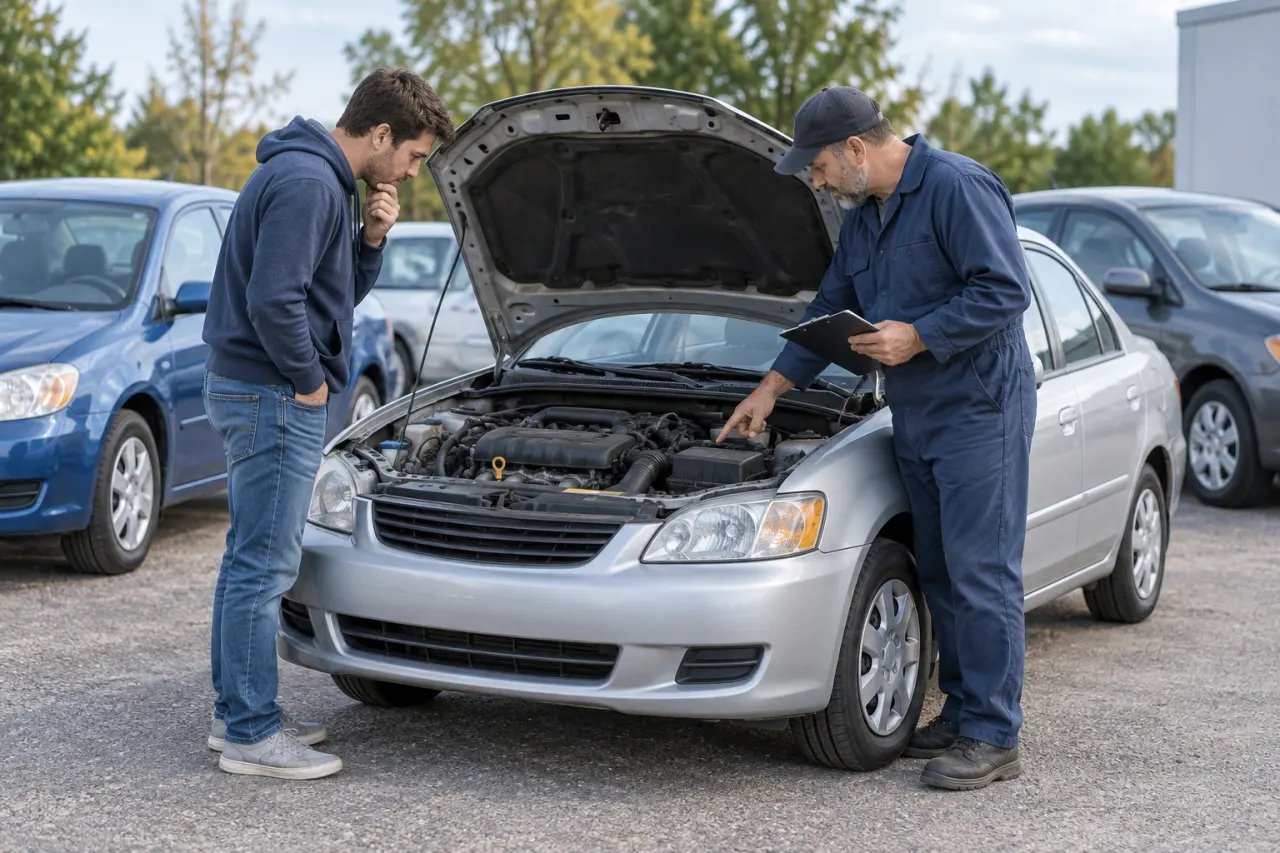
Arrange a pre-purchase inspection with a mechanic independent of the seller. Ask for engine, transmission, brakes, suspension, tires, cooling system, rust, electronics, and previous repairs to be assessed. Request a written distinction between urgent faults and routine future maintenance. Use Used Car Buying Checklist: What to Inspect Before You Buy to prepare.
Check VINs and available history, but remember that reports can miss events. Cars move between regions. Musty odors, unusual staining, corrosion in protected spaces, or unexplained electrical faults deserve investigation. Read How to Tell If a Used Car Was Flood-Damaged. A clean-looking cabin cannot rule out flood exposure.
Private seller, dealer, negotiation, and deposits
Private sellers may offer lower asking prices, but the process can be less standardized. Dealers offer inventory and may provide financing, while additional fees and optional products need scrutiny. Neither route is automatically cheaper or safer. Request an itemized total and verify ownership and transfer requirements.
Use comparable listings, inspection findings, service records, and credible repair estimates to negotiate. How to Negotiate the Price of a Used Car explains how to make an evidence-based offer without arbitrary lowballing.
Verify the vehicle, VIN, seller, and paperwork before paying. Understand deposit terms in writing and resist pressure to send money immediately. How to Avoid Used-Car Deposit Scams covers the checks to complete before reserving a car.
What to avoid under $10,000
Be particularly cautious about missing service history combined with unexplained symptoms, structural rust, flood exposure, unclear salvage or rebuilt history, major warning lights, transmission faults, overheating, and heavy modifications. An older luxury car with unresolved problems can bring repair obligations far beyond its purchase price.
A dramatically below-market advertisement needs an explanation and verification. Cheap reliable used cars do exist, but an inexpensive purchase can become costly when major work is needed. Do not use a discount to rationalize a car you cannot safely drive or afford to repair.
Your $10,000 used car buying checklist
- Set your total budget.
- Leave room for initial expenses.
- Compare multiple current listings.
- Check VIN, history, and open recalls.
- Review maintenance records.
- Inspect for flood and rust damage.
- Complete a safe test drive.
- Get an independent inspection.
- Estimate upcoming maintenance.
- Compare total ownership cost.
- Negotiate using evidence.
- Verify the seller and paperwork.
Buy the condition and history
The best used car under $10,000 is not necessarily the newest or lowest-mileage vehicle. A well-maintained car with a clear history and good inspection results can be better value than a newer one with hidden problems.
Browse used cars on DealsNonStop and compare price, mileage, age, condition, and seller information to see what is currently available within your budget.
Sources and methodology
Research date: November 1, 2026. The price table uses the dated IIHS/Black Book benchmark linked above, not live DealsNonStop inventory or completed local sales. Model-year search ranges are editorial starting points, not price guarantees. Mileage, trim, condition, location, fees, and market changes affect affordability. Manufacturer and NHTSA materials linked in the model sections support specific cautions; historical campaigns do not establish present warranty eligibility. Check NHTSA recalls and the manufacturer by VIN. No MPG, repair-cost estimate, reliability score, or guaranteed lifespan is claimed.